Top 15 Custom Sweatshirt Manufacturers in the USA
Ask any founder what their best-selling product was in year two, and...
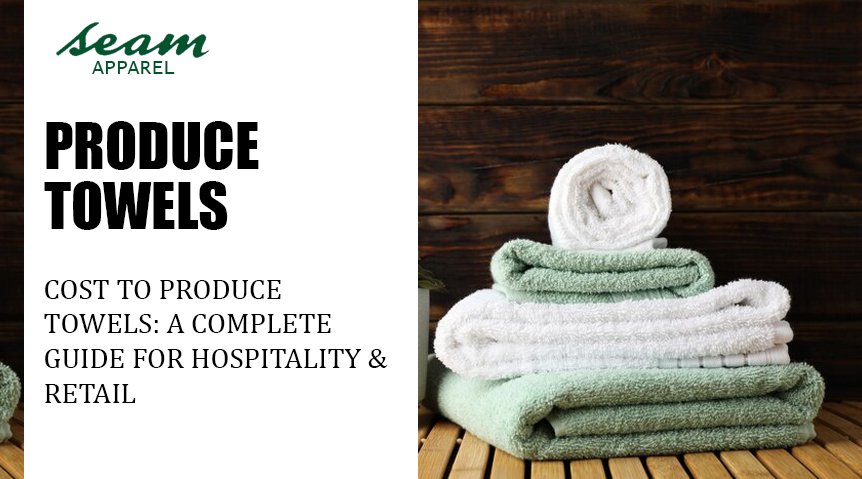
Most people do not think about towels much, but nothing moves off the shelf quicker in the hospitality and retail industry. Hotels replenish them by the truckload, spas change them out by the shift, and retail brands consider them a repeat purchase category. Anyone sourcing at scale eventually asks the same question: what drives towel manufacturing cost, and why do two identical towels land at such different price points? Working with experienced towel manufacturers early in the process makes that gap far easier to understand. This guide breaks down every factor so hospitality buyers, retailers, and private label brands can plan sourcing with fewer surprises.
The type of material and the quality of the fibers.
All these factors play a role in one another and that is why two towels that seem the same on a spec sheet can have vastly different price tags.
Material When it comes to any towel cost to produce dialogue, material is undoubtedly the largest factor. The fiber you select is the upper and lower limits of all the other factors.
The cost also is related to the method of spinning; the number of washes cycles the towel can withstand and the absorbency of the final loop. It is easy for buyers to see that the price to make towels does not always follow the specifications. It follows the entire fiber and finish.
One of the most obvious ways to tell if a quote is good is by the GSM.
The more fiber that can be contained in each square meter, the rawer material, the more drying time at the end of the line and the higher the cost per unit.
Before the first towel is shipped, there are hours of work spent at each stage of production:
A tighter tolerance and repeat batch color matched towel requires more time at each station, and this time is reflected in the invoice.
The most expensive part of the cost is branding, and the most important part of a commodity towel is making it a recognizable product. A collection of embroidered logos, typical of hotel and spa collections.
All of these do not alter the function of the towel. That is why brands continue to invest in them despite the extra cost because they alter the perception of their worth to the guest or shopper.
A low MOQ will invariably be more expensive per unit as setup and fabric minimums are distributed over fewer units. Fixed costs are distributed across hundreds or thousands of items in a bulk order, reducing the cost per item. Here, the groups of hospitality properties that order from one place will get the most benefit. Brands just starting out can work with low MOQ manufacturers while evaluating a collection before committing to bulk.
Rather than quoting exact figures that shift with cotton prices and shipping rates, it helps to think in tiers.
| Towel Tier | Material | Typical GSM | Branding Level | Relative Unit Cost |
| Basic, low MOQ | Standard cotton or microfiber | 300–400 | Minimal | Higher |
| Mid-range | Cotton or Turkish cotton | 400–600 | Woven label or light embroidery | Moderate |
| Premium, bulk | Egyptian cotton or bamboo blend | 600+ | Embroidery, jacquard, packaging | Lower per unit at volume |
This type of towel production cost breakdown provides a realistic picture of the cost before asking for formal quotes and it also helps to understand why a cost breakdown of towel production always works in favour of volume runs rather than one-off runs.
While it may be cheaper to go with a lower cut, the low price of a towel can lead to a reduction in fiber or GSM, which can cause the towel to become thinner, frayed, or less absorbent than the buyer had anticipated. This is a crucial aspect for hospitality businesses, as it directly impacts the guest experience. The higher quality of towels is more expensive but will last for more wash cycles and will retain their colours for longer.
Seam Apparel works with hospitality groups, retailers, and private label brands that need a dependable custom textile manufacturing partner rather than just a factory quote. The team helps clients choose fibers and GSM to ensure they get the right combination for their needs, ensures that no fibers make it to bulk production without being evaluated, and allows for flexibility in MOQs for brands just beginning their custom towel manufacturing line. With a business of supplying hotel towels and private label, Seam Apparel is dedicated to ensuring that the cost-to-quality ratio is right the first time, not the 10th. When purchasing a wholesale towel manufacturer for a rollout of towels across multiple properties, consistency of repeat orders is just as important as the price.
Towel manufacturing cost always comes back to the same core inputs: fiber, GSM, labor, and how many units sit on the order. Bulk production brings the per-unit price down meaningfully, while customization and branding add value many buyers consider worth the premium. Working with a manufacturer that understands custom apparel manufacturing end to end, and that treats product development and sampling as a real stage rather than an afterthought, makes the difference between a program that scales smoothly and one that runs into costly surprises. A clear look at clothing manufacturing cost structures across categories, paired with a trusted hotel towel supplier relationship, sets up every reorder for lasting custom towel manufacturing success.

Ask any founder what their best-selling product was in year two, and...
Introduction Towels are the quiet workhorse of home, hospitality, and retail. Nobody...

Leggings carry more weight than any other product in an activewear line....
A hat looks simply until you must specify one. Panels, sweatband, closure,...

Shorts sit in more categories than almost any other garment: gym, beach,...