Top 15 Custom Sweatshirt Manufacturers in the USA
Ask any founder what their best-selling product was in year two, and...
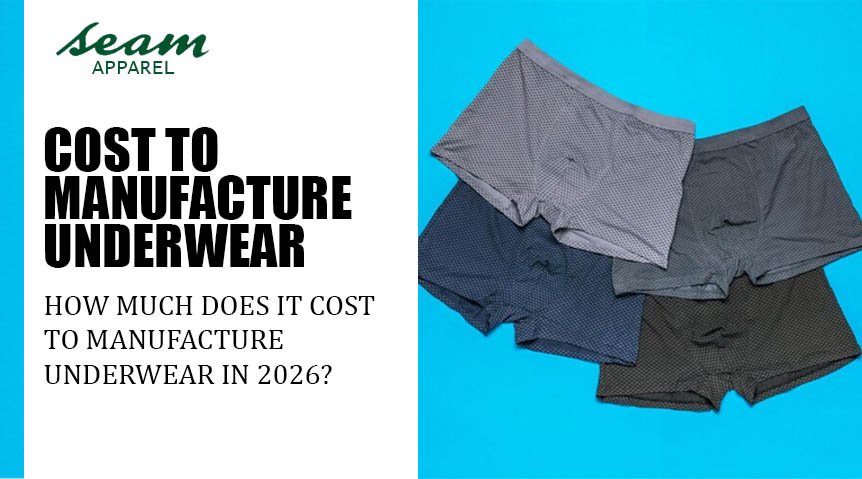
Underwear looks simply. Small garment, not much fabric, how hard can it be? That assumption is exactly why first-time brands get surprised at the invoice. The precision required in construction, the trims that stack faster than expected, the fabric premium separating a product people repurchase from one they return — none of it is obvious until you have been through a production run. Working with an experienced underwear manufacturer before sampling means getting actual cost data before committing to anything. That is the whole game.
Five things set your per-unit cost. Fabric type first — cotton, modal, bamboo, and elastane blends do not just feel different, they cost quite different amounts per yard. Design complexity follows, because a plain brief and a boxer brief with a fly opening and flatlock seams are not the same manufacturing job. Customization is where most brands spend more than planned. Volume is the biggest single lever on per-unit pricing. And manufacturing location shifts labour cost significantly.
Miss any of these in early planning and the budget is fiction.
How To Start A Men’s Underwear Line Costing, Market Value, And Strategies
Standard cotton jersey runs $2.50 to $5 per yard. Breathes well, dyes cleanly, and covers most mass-market underwear programs. Add 5% to 10% spandex for stretch and recovery without much cost change.
Modal fabric is a different product entirely. Softer than cotton, smoother against skin, better at moisture absorption, and it resists pilling and shrinking in ways cotton simply does not. Cost runs $5 to $10 per yard. For a brand positioning around premium daily wear, modal fabric is not a nice upgrade. It is the product. Bamboo jersey sits at $6 to $11 per yard and carries sustainability credentials a growing segment of 2026 buyers specifically seeks out.
One number that consistently surprises people: fabric accounts for 35% to 45% of total per-unit manufacturing cost. On a small garment. That percentage.
How Much Does It Cost to Manufacture Underwear in 2026?
Plain elastic waistband: $0.20 to $0.60 per unit. Fine.
Branded woven waistband with the brand name running around it: $0.80 to $2.50 depending on jacquard complexity. Decorative lace trim for women’s styles adds $0.30 to $1.00. Woven care label adds $0.10 to $0.25. Throw in a hangtag and you have $1.50 to $3.50 per unit in trims alone — before stitching starts. Brands that build a budget around fabric and labour and forget trims are working with a hole in their spreadsheet.
The garment is small. The precision requirement is not. Waistband attachment, flatlock seam construction so nothing chafes, crotch panel joining — these all require accuracy that shows immediately when it is off. You feel a bad seam placement. You feel twisted elastic. That becomes a return.
Basic styles run $1.50 to $3.50 per unit in labour. Boxer briefs with fly openings, bonded-edge seamless styles, anything with functional construction specifics pushes $3 to $6. Experience in the operator matters more here than in most other garment categories.
Private labelling for underwear is the full brand package — branded waistband, care label, polybag or retail box, tissue if you want it. Basic level: $0.80 to $2.00 per unit. Premium retail packaging with window box and custom tissue: $2.50 to $4.50.
The mistake is treating private labelling as a finishing step. It is not. Waistband specs, logo placement, and packaging format need to be locked before sampling. Change them after approval and you are resampling. That costs time and money.
| Order Size | Estimated Per-Unit Cost (Basic Underwear) |
|---|---|
| Under 200 units | $7 to $12 |
| 200 to 500 units | $5 to $8 |
| 500 to 1,000 units | $3.50 to $6 |
| 1,000+ units | $2.50 to $4.50 |
Pattern making per style: $100 to $300.
Two sample rounds: $150 to $400. Fixed costs.
They do not shift based on order size — only what they spread across changes. That is the entire explanation for why low-volume production costs more per piece. There is no negotiating around it.
For anyone working through how to start a men’s underwear line or a women’s basics range from scratch: start with two styles, not twelve. Brands that try to launch a full range at low MOQ burn sampling budget before a single style is proven at retail. How to start a men’s underwear line planning that keeps the initial range tight consistently outperforms one that launches wide.
Three things are changing the cost picture.
Sustainable fabric demand is real and prices reflect it. Bamboo, organic cotton, and modal are all seeing sourcing pressure. Before locking a spec, understanding the full range of eco-friendly materials for clothing and what they cost right now is worth doing. Eco-friendly materials carry genuine price premiums in 2026 — but the retail pricing power they create typically more than covers the production gap.
Low MOQ manufacturing is more accessible than it was. More factories offer it. Per-unit cost at low volumes is still what it is, but access has improved for startups. And premium basics are outperforming mass basics across retail channels, making the cost premium for modal over standard cotton increasingly easy to justify at the price tag.
Launching ten styles instead of two. Ordering a branded waistband before the core product is proven. Specifying retail box packaging before volume justifies it. Splitting colourways into separate production runs instead of batching together. None of these are hard to avoid. They just require decisions made before sampling, not during it.
The elastic pulls, the fabric pills, the seam sits wrong after three washes — customers do not quietly return it. They write about it. In a category where comfort and consistency are the entire value proposition, unrespecting the product to save $0.80 per unit is the most expensive decision a brand makes.
Seam Apparel works with basics brands, private label businesses, and e-commerce apparel brands on underwear production requiring precise construction, reliable fabric sourcing, and delivery that arrives on schedule. Flexible MOQs work for startups on a first run and brands scaling proven styles. The right underwear manufacturer for this category understands flatlock construction, why waistband tension must hold across a full-size run, and how to keep quality consistent across thousands of small garments.
A basic cotton brief at reasonable volume: $3.50 to $6 per unit before shipping. A premium modal style with branded waistband and retail packaging: $8 to $14. Factor in sampling, coordination, and trims from the start and the budget holds. Build around guesswork and the invoice tells you what you missed.

Ask any founder what their best-selling product was in year two, and...
Introduction Towels are the quiet workhorse of home, hospitality, and retail. Nobody...

Leggings carry more weight than any other product in an activewear line....
A hat looks simply until you must specify one. Panels, sweatband, closure,...
Shorts sit in more categories than almost any other garment: gym, beach,...