How to Choose the Right Fabric for Towels: Full Guide
Introduction Towels are the quiet workhorse of home, hospitality, and retail. Nobody...
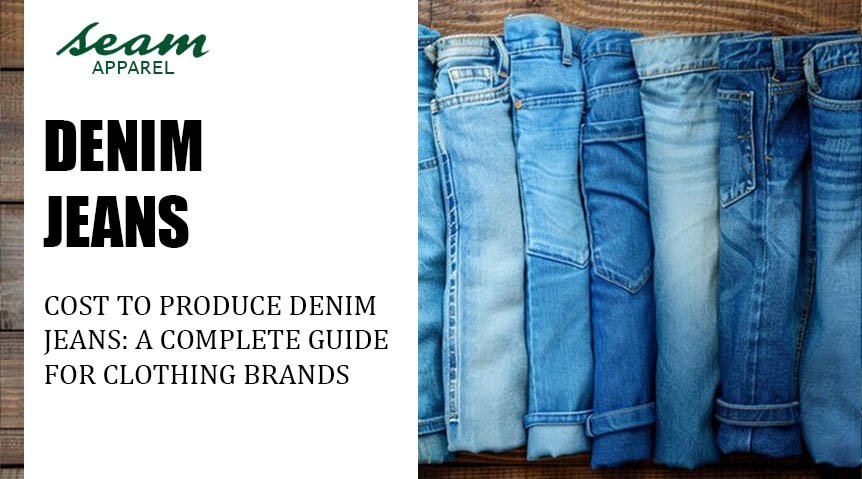
Jeans look simply. Two legs, a waistband, five pockets. The production cost behind them is anything but. Denim is one of the most construction-intensive garments in casual fashion, and the washing and finishing processes alone add costs that no other apparel category deals with at the same scale. Brands working with experienced jeans manufacturers before placing their first order are in a far better position than those who get the cost breakdown after sampling. This guide covers every cost driver, so nothing catches you off guard.
Tips for starting a denim line
Six things determine where your per-unit production cost lands:
Standard cotton denim runs $4 to $8 per yard. Stretch denim — typically cotton with 1% to 3% elastane for slim and skinny fits — costs $5 to $10. Selvedge denim, woven on narrow shuttle looms and favoured by premium brands, can reach $15 to $30 per yard or more.
Understanding denim fabric properties — weave structure, weight in ounces, cotton quality — is the foundation of any fabric decision that matches your brand positioning and budget. Raw denim fabric skips pre-washing and costs less upfront, but it shrinks and fades significantly with first wear. Most commercial production uses pre-washed fabric to eliminate that variable for the end customer.
Most commercially produced jeans use a polyester and cotton blend or cotton-spandex construction rather than 100% cotton. Polyester and cotton blend fabric costs less than pure cotton, resists wrinkling, and holds shape through repeated washing. The trade-off is breathability and the premium hand feel that a full-cotton jean delivers. Choosing the right blend for your price point and customer is a sourcing decision that affects both production cost and real-world product performance.
The typical five pocket jean has five rivets, one main button, a zipper, two pocket bag linings, and various labels. The cost of a basic pair is $1.50 to $4 for the whole trim. Premium cast-metal buttons and branded rivets add to that. It is common for first time brands to underestimate trims. They should not.
From here on, denim takes a turn for the worse with all other clothing categories. Washing is not a finishing detail, it is the appearance of the product, and it has a cost associated with it. A basic rinse wash adds $0.50 to $1.50 per unit. The price of stone or enzyme washing is $1.50 to $4. The price of acid washing is $3 to $6. Distressing, whiskering or hand sanding is $3 to $8 depending on the complexity. Laser finishing for precision fading runs $4 to $10. A pair going through a full distress-and-wash treatment can carry $8 to $15 in washing costs alone — separate from fabric, trims, and labour.
Brands building washed or distressed collections need to treat washing as a core production line item from day one. It is not an afterthought.
Denim is harder to cut cleanly and harder to sew than lighter fabrics. Topstitching requires more precision. Reinforced inseams, bar tacking at pocket corners and stress points, and the construction of functional pocket bags all add time per unit. Skilled cut and sew production for denim runs $4 to $9 per unit for basic styles and $8 to $14 for more complex fits and construction. Experienced cut and sew manufacturers who work with heavy fabric consistently deliver consistent seam quality and accurate sizing across the full-size run — both of which are immediately visible problems in denim when they go wrong.
| Order Size | Estimated Per-Unit Cost (Basic Jeans) |
|---|---|
| Under 200 units | $18 to $28 |
| 200 to 500 units | $12 to $18 |
| 500 to 1,000 units | $9 to $14 |
| 1,000+ units | $7 to $11 |
Pattern making for a modern style costs $200 to $500. Two sample rounds add $300 to $600. Fabric minimums at the mill level sometimes require buying more yardage than a small run needs. Every one of those fixed costs divides across your order volume. Low-volume denim production is expensive. That is not a manufacturer problem — it is the math.
Utilize a clothing manufacturing cost sheet
Embroidery on back pockets adds $1 to $3 per pair. Custom woven patch labels add $0.30 to $0.80. Unique contrast stitching costs almost nothing beyond thread choice. Screen printing on denim performs poorly and is rarely used. The highest-impact customization in jeans is the wash and distress treatment — it defines the finished product more than anything else.
Three decisions that work:
Seam Apparel works with denim and streetwear brands on runs that require precise fabric sourcing, wash coordination, and construction quality across full size ranges. If you are putting together a cost to start a clothing line budget that includes denim, the cost data needs to be accurate at the sourcing stage — not discovered after sampling. Effective cost to start a clothing line planning that accounts for washing, trims, and MOQ realities from the beginning is what produces a budget that holds. Working with a manufacturer who are transparent about those costs upfront is what makes denim production viable for emerging brands.
A basic pair of jeans produced at reasonable volume realistically lands between $9 and $14 before shipping. A washed, distressed, premium style can reach $20 to $30 per unit. Understanding where every dollar goes is the only way to price your product correctly, protect your margins, and build a denim brand that makes commercial sense from the first run.
Introduction Towels are the quiet workhorse of home, hospitality, and retail. Nobody...

Leggings carry more weight than any other product in an activewear line....
A hat looks simply until you must specify one. Panels, sweatband, closure,...

Shorts sit in more categories than almost any other garment: gym, beach,...

Introduction A tank top is about as simple as clothing gets. Two...